Live prices · moment by moment
Gold Price Today in the USA (US dollar)
Price by karat
Prices are for raw gold before making charges. They are a guide, not an offer to buy or sell.
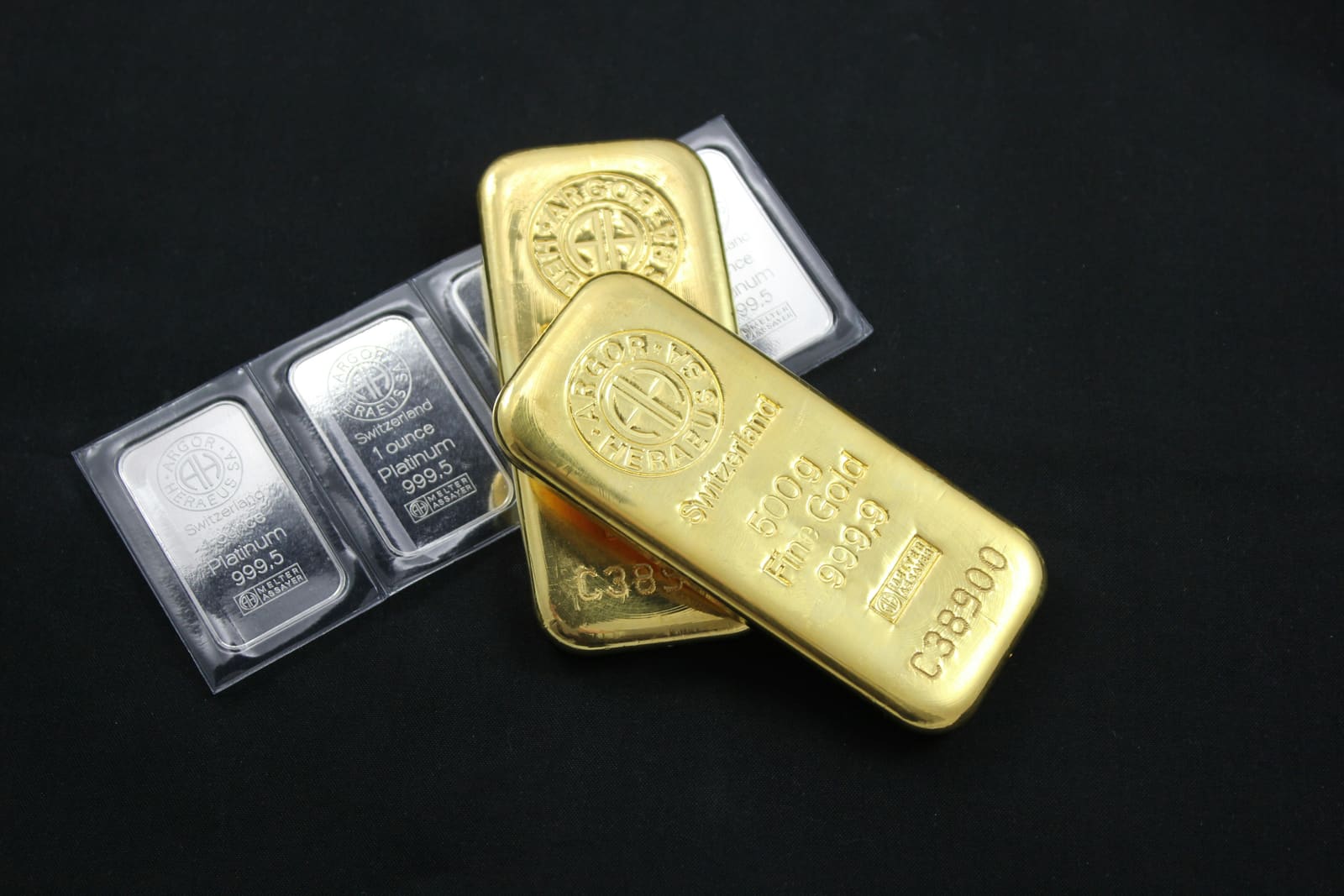
Gold bar prices today (24K)
The estimate includes the dealer's premium, which gets smaller as the bar gets bigger.
| Size | Raw value | Estimated price |
|---|---|---|
| 1 g | 130.92 USD | 145.32 USD |
| 5 g | 654.61 USD | 683.41 USD |
| 10 g | 1,309.21 USD | 1,349.53 USD |
| 20 g | 2,618.42 USD | 2,681.79 USD |
| Troy oz | 4,072.10 USD | 4,152.73 USD |
| 50 g | 6,546.05 USD | 6,654.06 USD |
| 100 g | 13,092.11 USD | 13,264.92 USD |
| 1 Kilo | 130,921.06 USD | 131,929.15 USD |
| Gold pound 8 g 21K | 916.45 USD | 943.94 USD |
Gold price yesterday and previous days
Closing prices of the last 7 sessions for each karat.
| Date | 24K | 22K | 21K | 18K |
|---|---|---|---|---|
| Nov 6, 2026 | 131.01 | 120.09 | 114.63 | 98.26 |
| Nov 5, 2026 | 132.25 | 121.23 | 115.72 | 99.19 |
| Nov 4, 2026 | 130.95 | 120.04 | 114.58 | 98.21 |
| Nov 3, 2026 | 126.69 | 116.13 | 110.85 | 95.02 |
| Nov 2, 2026 | 127.63 | 116.99 | 111.67 | 95.72 |
| Oct 30, 2026 | 125.35 | 114.91 | 109.68 | 94.01 |
| Oct 29, 2026 | 129.61 | 118.81 | 113.41 | 97.21 |
Values at today’s exchange rate (USD)
Gold forecast today: buy or sell?
For the long-term investor
Over 1 year
SellOver 3 years
Strong buyIndicator details
| Indicator | Value | Signal |
|---|---|---|
| RSI (14) | 46.98 | Neutral |
| Stochastic (14,3,3) | 70.94 | Neutral |
| CCI (20) | -7.58 | Neutral |
| ADX (14) | 21.12 | Sell |
| Awesome Oscillator | -103.77 | Neutral |
| Momentum (10) | 64.20 | Buy |
| MACD (12,26) | 11.69 | Buy |
| Stoch RSI Fast (3,3,14,14) | 95.40 | Neutral |
| Williams %R (14) | -31.02 | Neutral |
| Bull Bear Power | 35.74 | Neutral |
| Ultimate Oscillator (7,14,28) | 48.85 | Neutral |
| Indicator | Value | Signal |
|---|---|---|
| EMA (10) | 4,048 | Buy |
| SMA (10) | 4,026 | Buy |
| EMA (20) | 4,082 | Sell |
| SMA (20) | 4,081 | Sell |
| EMA (30) | 4,121 | Sell |
| SMA (30) | 4,112 | Sell |
| EMA (50) | 4,179 | Sell |
| SMA (50) | 4,230 | Sell |
| EMA (100) | 4,263 | Sell |
| SMA (100) | 4,233 | Sell |
| EMA (200) | 4,281 | Sell |
| SMA (200) | 4,501 | Sell |
| Ichimoku Base (9,26,52) | 4,058 | Neutral |
| Hull MA (9) | 4,056 | Buy |
Readings may differ slightly from other sites.
For guidance only, not advice to buy or sell.
Live gold ounce price
Frequently asked questions
Why is the gold price quoted per ounce in the US?
US dealers quote gold per troy ounce (31.1035 g), the unit of the world spot market. This page shows the ounce in dollars and converts it to per-gram prices for every karat, so you can compare jewellery, coins and bars on the same basis.
How much above spot should I pay for coins and bars?
The premium over spot covers minting, distribution and the dealer's margin. Typical ranges are a few percent for one-ounce bars and popular coins such as the American Eagle or Maple Leaf, more for fractional sizes. Anything far above that deserves a second quote.
Is gold taxed in the United States?
Sales tax on bullion depends on the state: many states exempt investment gold above a threshold, others tax it. Profits on sale are taxed federally as collectibles gains. Check your state's rule before buying.
Which karat is common in US jewellery?
14K (58.5% gold) is the most common for everyday jewellery, with 18K for finer pieces and 10K for the most durable, cheaper items. 24K is reserved for bars and coins. Prices here scale with purity: 14K is 14/24 of the 24K gram price.
Why is there no hallmark on American gold?
The US has no compulsory assay system; the karat mark is the maker's declaration, backed by federal law on accuracy and by the maker's trademark next to it.
Is gold taxed when I buy it in the US?
There is no federal tax; state sales tax applies in some states and not in others, often with an exemption for investment bullion above a threshold.
What is the pennyweight?
One twentieth of a troy ounce, 1.555 grams; scrap buyers often quote per dwt.
How is gold taxed when I sell?
As a collectible: long-term gains are taxed at up to 28% federally, so keep the purchase invoice to document what you paid.
About the gold price today in the USA
Gold price today in the USA, Saturday, November 7, 2026: 4,072.10 USD per ounce; 24K = 130.92 USD, 22K = 120.01 USD, 18K = 98.19 USD per gram. Updated 15:12 EST.
Today's gold price in the USA in US dollar for every karat, worked out from the world ounce price and the exchange rate. US retail gold is usually quoted per troy ounce for bullion and by karat (14K, 18K) for jewellery; there is no federal VAT, but state sales tax may apply.
Prices are for raw gold before making charges. Use “Fair price” to check a making charge or what your gold is worth when you sell, and the zakat calculator for zakat.
The US gold market: what makes it different
The United States is where the world gold price is set and quoted: in dollars per troy ounce, around the clock on the futures and spot markets. For an American buyer that means the price on this page needs no exchange-rate step at all; the ounce price divided by 31.1035 is the gram price of pure gold. What differs from most other countries is everything around the price: karat marks instead of purity numbers, no national hallmark, sales tax that depends on the state, and a retail market split between bullion dealers and jewellers.
Karats: 14K is the norm, 10K is the legal floor
American jewellery is mostly 14K (58.3% gold), with 10K (41.7%) at the budget end and 18K (75%) for fine jewellery; 22K and 24K appear in bullion and in jewellery made for South Asian and Middle Eastern customers. Federal law sets 10K as the minimum fineness that may legally be called gold, and the National Gold and Silver Stamping Act requires a quality mark such as "14K" or "585" to be accurate within a small tolerance and to be accompanied by the maker's registered trademark. There is no assay office stamp: the mark is the maker's claim, which is why reputable sellers and independent testing matter more here than in countries with compulsory hallmarking.
Units: the troy ounce, the gram and the pennyweight
Bullion is quoted per troy ounce (31.1035 g); at today's price (November 7, 2026) the ounce is 4,072 dollars, a gram of pure gold 130.92 dollars and a gram of 14K 76.37 dollars. Jewellers and scrap buyers also use the pennyweight (dwt, 1.555 g, twenty to the troy ounce), so a scrap offer "per dwt" must be multiplied by 0.643 to compare with a per-gram price. Coins come in one ounce and fractions: the American Gold Eagle (22K, one ounce of fine gold plus alloy) and the American Buffalo (24K) from the US Mint, alongside the Maple Leaf, Krugerrand and Britannia.
Taxes: no federal VAT, state sales tax, and capital gains at the collectibles rate
There is no federal sales tax or VAT. State sales tax on bullion and coins varies: many states exempt investment bullion and legal-tender coins, often above a minimum purchase amount, while others tax every sale; check your state before buying online, because the dealer applies the rate of the delivery address. Jewellery is taxed as any other retail purchase. On resale, physical gold is treated by the IRS as a collectible, so a long-term gain is taxed at a maximum federal rate of 28%, higher than the rate on shares; keep the purchase invoice to document your cost basis.
Premiums and making charges
Bullion dealers quote a premium over spot: a few percent on one-ounce coins and bars, more on fractional sizes, less on kilo bars, with a buy-back price a little under spot. Jewellers quote a piece price that bundles the metal, the making charge and the margin; the making charge in the United States is usually a percentage of the metal value rather than a per-gram figure, and in branded stores it can exceed the gold value itself. The fair price tool separates the two so you can see what you are paying for the gold and what for the work.
Selling gold in the US
Scrap buyers, pawn shops, local jewellers and mail-in refiners all buy gold at a share of its melt value: a reputable local buyer typically pays 85–95% of the melt value for karat gold, mail-in services often less. Have the piece weighed in front of you, confirm the karat (a quick acid or XRF test is normal), and compute the melt value yourself: weight × karat ÷ 24 × today's gram price. Coins and bars from known mints sell close to spot through bullion dealers.
Tips for buyers in the US
- For saving, buy recognised coins or bars from an established dealer and compare the premium over spot, not the total price.
- For jewellery, ask for the metal weight and karat on the receipt; the making charge is the only negotiable part.
- Check your state's sales-tax rule on bullion before ordering.
- Keep invoices: they set your cost basis for capital gains tax and prove the karat when you sell.
- Follow the day-by-day archive to see where today's price sits in the recent range.
Frequently asked questions
Why is there no hallmark on American gold?
The US has no compulsory assay system; the karat mark is the maker's declaration, backed by federal law on accuracy and by the maker's trademark next to it.
Is gold taxed when I buy it in the US?
There is no federal tax; state sales tax applies in some states and not in others, often with an exemption for investment bullion above a threshold.
What is the pennyweight?
One twentieth of a troy ounce, 1.555 grams; scrap buyers often quote per dwt.
How is gold taxed when I sell?
As a collectible: long-term gains are taxed at up to 28% federally, so keep the purchase invoice to document what you paid.
Read also
- How the gold price per gram is calculated from the ounce price, with examples for every karatGold is priced worldwide in dollars per troy ounce, and every gram price in every currency is derived from it by one formula. We walk through it step by step with today's figures for 24K, 22K, 21K, 18K and 14K, and explain why a shop's price differs from the result.
- 24K, 22K, 21K, 18K, 14K and 9K explained: purity, uses and which karat to buyA karat is the share of pure gold in a piece out of 24 parts. We explain what each karat means, why countries favour different karats, how purity drives price, hardness, colour and resale value, and which karat suits saving and which suits wearing.
- Making charges and hallmarks: how they are calculated and how to negotiate themThe making charge is the only negotiable part of a gold price. We explain what it covers, how it is quoted per gram or as a percentage in different markets, what a hallmark is and who strikes it, and how to work out the real making charge in any offer in a minute and negotiate it with numbers.
- Selling scrap gold: what is deducted and why, and how to avoid losing moneyWhen you sell used gold the buyer pays its melt value less a deduction and never refunds the making charge. We explain every deduction one by one, how to compute what you will receive at today's price, when an exchange beats a sale, where to sell, and the mistakes that cost sellers the most.
- The gold pound and the Sovereign: weight, karat, price, and when a coin beats a barThe Egyptian gold pound is 8 grams of 21K, the British Sovereign 7.98 grams of 22K; both are priced by their fine-gold content plus a small premium. We explain how they differ, how they are priced and sold, how they compare with the Krugerrand, the Eagle and the Britannia, and when a coin is the better choice over a bar.
- Zakat on gold and silver: the nisab, the lunar year and worn jewellery, with worked examplesA complete guide to zakat on gold and silver: the conditions, the nisab (85 grams of gold and 595 grams of silver) and its value today, the Hijri year, the schools' views on worn jewellery with the fatwa authorities' positions, mixing karats, combining silver with gold, and examples worked step by step.